Saturday, August 27, 2011

Animation Blog Roll

I’ve been meaning to do a round up of blogs I like for some time, so now is as good a time as any. Animation artist blogs or animation studio blogs come in many varieties. Some are strictly online portfolios, while others offer behind-the-scenes looks at the state of the art form or uncover its history. Here’s a round up of blogs (in no particular order) that I check out everyday, and the reasons why.


The Frederator blog, a collection of posts by Fred Seibert, Eric Homan, and their associates, celebrates the art form and its artists. Besides giving countless newcomers their first public nod, this blog also takes readers behind the scenes showing how hit series such as "Adventure Time" (pictured above) and "Fan Boy & Chum Chum" are made. I can’t think of a more transparent production than "Adventure Time," for instance, in that it appears that every model sheet and background painting made for the series has been posted for viewing. Since the quirky show is the most game-changing animated series since "SpongeBob," this is nothing to sneeze at. Add to this the entrepreneurial musings of Fred Seibert, forever encouraging readers to re-invent themselves and their industry, and to do it all with passion, joy, and enthusiasm.

When I worked for Michael Sporn, for an all-too brief two years, I made sure that (besides Michael) I was the first person in the studio each morning. That meant a leisurely conversation with Michael at the back table over tea. It was my chance to ask him how he made his groundbreaking films and he’d recount each experiment with pleasure, aptly demonstrating his love of animation and filmmaking. One morning he pulled out some issues of his old studio newsletter called Sporn-O-Graphics, which made for a great record of his early 1990s output as well as time capsule of the overall era. Other mornings Michael would suddenly get up, pry open a box on a nearby shelf and pull out original layouts from Raggedy Ann and Andy, or drawings by John Hubley, among others. These morning chats are now available to everyone through Michael’s daily splog posts. If you like your animation discussion from a responsible and reliable source who was there, worked with many of the greats, and is leaving his own mark on the art/industry, then this is the blog for you.

The only time I disagree with Mark is on the subject of pitching and development, but I don’t let that stop me from enjoying his intelligent observations on the business, industry, and art of animation at Mayerson on Animation. From copyright issues, to studies and mosaics of classic animation, to issues faced by students and recent graduates, Mark’s blog covers it all. Best of all, he’s rational, balanced, and level-headed, something in short supply on the Internet.


As a teacher at NYU’s Tisch School of the Arts, I had the pleasure to meet the latest wunderkind to emerge from the program, the multi-talented Stephen P. Neary. After wowing the festival world with his quirky and delightful student films such as “Shark Suit,” and “Chicken Cowboy,” Stephen graduated and was immediately snatched up to work in the story department of Blue Sky. For so many, scoring a dream gig like that would mean putting any personal projects on hold, but not for Mr. Neary. He’s been busying himself making further short films such as “Let’s Make Out,” and the upcoming, “Dr. Breakfast,” as well as creating book and feature proposals, and otherwise scribbling lovely observations into his sketch books (pictured above). Oh, I forgot to mention, Stephen is a hell of a nice guy, making it all the more fun to go along on his journey and cheer him on.

I come to Scribble Junkies in part to read Bill Plympton’s unusual reviews of the many films he watches (its especially fun to read him objectively criticize the work of friends––even ones as powerful as John Lasseter), in part to be a fly on the wall as Bill reports on his never ending animation world tour, and to read Pat Smith’s surfer/rock-star take on being an artist/animator. Bill and Pat are two of the most active indies in the world and for that reason alone they make an exciting combination. They share an infectious “can do” spirit that makes you want to finish a film and then promote your work with gusto.

No other blog best captures the ins-and-outs of running a successful small animation studio than Ace & Son owner/operator’s Richard O’Connor’s blog. Go deep into his archive at his old address to find invaluable posts on budgeting, pipeline, and all aspects of doing business. His discussions on the creative side are no less insightful. Richard and I began our careers in animation in NYC during the same year but have charted very different paths. Even though it is not my goal to operate a traditional studio as Richard does, I admire his ability to hold a bustling studio together, to get work, and how he shares his knowledge and experiences to help others navigate this difficult business.


The overgrown kid known as Mr. Warburton has achieved a lot in his 20-year (and counting) career (note the page above from his first job hunt journal heralding his hire at Buzzco). Once the poster child of NY animation success (going from employment at studios from Buzzco to J.J. Sedelmaier to creating and producing his own long-running series for Cartoon Network), he has since packed up to reboot his career in L.A., currently supervising retakes for the Disney TV series “Fish Hooks.” Despite his level of achievement, Mr. Warburton’s blog somehow manages to feel like the fresh enthusiastic observations of someone just starting out. This is a man appreciating life working in a field he loves.


Like an indie version of the Frederator blog, brothers Tim and Mike Rauch have been extremely transparent in sharing their production process (pictured above, Tim's design studies for Miss Devine), collaborations, thoughts, and research behind their acclaimed StoryCorps animated films. These guys did things the hard way, creating work on their terms, and giving hope to today’s generation of animation talent that there’s another option besides lining up for a more conventional job or internship in the field.

Monday, August 15, 2011

The Festival of Drawn Animation

(From left to right, animators Fran Krause, Colleen Cox, Pat Smith, and Bill Plympton during the closing Q and A at The Scribble Junkies Festival of Drawn Animation. Terrible iphone photography by me.)

Last week I had the pleasure of attending the first Scribble Junkies Festival of Drawn Animation, the brain-child of animators Bill Plympton and Pat Smith. The two high profile artists already share a blog, a passion for hand drawn traditional animation, and now have collaborated to curate and present this new festival. Their choice of venue, the new Nitehawk Cinema in Williamsburg, Brooklyn, helped set the tone of a relaxed and celebratory atmosphere. Maybe that’s because there were drinks to be had in the Cinema’s bar before and after the show? I, for one, very much appreciated the Magner’s Cider on tap. *burp*

As recently as fifteen years ago 2D drawn animation was still THE main technique of animation around the world, as it had been for nearly a century. If someone had called an event a “drawn” animation festival back then, it would have seemed redundant. Today such a distinction makes total sense. But, the “drawn” credo is more than just a snappy title or a way to position itself apart from what the big CGI studios are doing in features. As I watched the selections of the evening, I began to realize the artists behind these films wanted us to see their individual drawings. Many of these films are about drawing, both technically, and in the psychological sense by what happens when the artist loses his/her self in the act of drawing.

Masks by Pat Smith.

I appreciate this new festival’s focus, especially in how it forced me to look at a few films in a new way. For example, Pat Smith's "Masks" benefitted from the viewer's requirement to experience each film in the context of drawing being the most important element. Drawing and animating are Pat's strengths (check out his wonderful commercials posted here), so even though "Masks" began as an audio track created by composer Karl von Kries, it's the visuals that dominate the experience. Upon seeing this film some months ago, animation artist Adrian Urquidez remarked, "You can tell this guy loves to draw." In short, a perfect candidate for this screening.

David Chai is one of today’s most decorated and prolific humorous animated filmmakers, sort of like a disciple of Bill Plympton, but his “Enrique Wrecks the World,” (which is a crowd pleaser on the festival circuit) seemed a little out of place here. Maybe I wouldn't have felt this way if the short was programmed later in the show, but as the opener, I expected something a little more visually compelling––something to showcase all that drawn animation can be.

Pat Smith introduced “The Music Scene” by Anthony Schepperd as being a former student of his, making the claim that the student was better than the teacher. The film is was wonderfully inventive and imaginative.

Rebecca Sugar, one of the most amazing talents to come out of SVA in recent years (and there’s been a lot of competition), was represented with “Johnny Noodleneck,” which, like her thesis film “Singles,” featured terrific drawing and quirky, brilliant, and idiosyncratic character posing. It was a treat to see another work by the gifted artist, even though it appeared to be a less polished earlier work when compared to her more mature thesis film.

Wrong Number Singapore by Colleen Cox.

A real highlight for filmmaking in the show was “Wrong Number Singapore,” which Colleen Cox animated to a popular viral audio recording circulating around Singapore. I loved the designs, acting, animation, and frenetic crackle of the short, which depicts a phone call gone terrible wrong. Keeping the film language to a minimum was a great move because it let Colleen have a field day animating these raving characters in a way so the staging didn’t get in the way.

Thought of You by Ryan Woodword

Thought of You” by Ryan Woodword went toe to toe with Bill Plympton’s excerpt of “Cheatin” as the most beautiful animation in the festival.

I was very happy to finally get to see Don Hertzfeldt’s “Wisdom Teeth,” after having missed it at several other festivals. It was a curious one-joke experiment, and judging from the laughs in the audience, a successful one. It reminded me of the filmmaker’s free spirited earlier work before he attempted the more structurally sophisticated “I’m So Proud of You,” and “Everything Will be Okay.”

Nosy Bear” by Fran Krause should almost be required by law to be accompanied by the lovely and inspirational making-of video showing the short’s peculiar production process. But, in all seriousness, “Nosy Bear,” holds its own quite nicely, and the only fault I can find with it (and it’s probably not a flaw at all) is that it’s far less ambitious than Fran’s previous films such as “Mister Smile,” “Moon Raker,” or his daring video collaboration with his brother Will “Dog in a Burning Building.”

“Summer Bummer” a new two-minute short by Bill Plympton, was made for Showtime (same as Hertzfeldt’s “Wisdom Teeth”), and made in about one week. I need to see this one again because the images came so fast and furious that I lost the thread at one point. But, that could just be me, and I may not feel that way on a second viewing. Thematically, it covers similar territory to Bill’s Oscar-nominated “Guard Dog” in that the main character imagines terrible and impossible dangers looming around every turn. There was some lovely animation and sophisticated layouts in the film, both of which demand another look.

Codswallop” by the Brothers McLeod artfully presented two scenes at once, much like the explorations of animator Paul Driessen. I’m not sure I always understood what was going on, but I wanted to see this again. It seemed like one of the classier productions in the show.

Let’s hear it for Bill Plympton and Pat Smith! Their maiden festival was sold out, and they have plans to make this an annual event, spread over a couple of days of screenings. If there’s one thing the NY animation community has proved, there can’t ever be enough venues for animators to view films. If they build it, we will come. Especially if there’s cider on tap.


Thursday, August 11, 2011

Feedback


I’ve been surprised and delighted at the positive reception of my short Grandpa Looked Like William Powell. The film is about halfway through its festival run and still receiving invites from festivals around the country. It was gratifying to be accepted into competition at some major festivals, but one of the biggest kicks I got was from reading notes on the film made by the jury of the Animazing Spotlight festival, where they voted my film a 2011 Quarterly winner. I know that getting such feedback can’t always be a pleasant (or even useful) experience, but the messages on my film turned out to be interesting and provocative. I'm not a famous or highly regarded filmmaker so it's a rare treat to read any words on a short film of mine. And, since shorts don't get half the attention, reviews, or respect that feature films do, I'll enjoy this while it lasts.

All this encouragement inspired me to go to the trouble (which included making two 35 mm prints of the film, as pictured above) to qualify "Grandpa" for the Academy Awards. Maybe I'll have a shot if some of the Academy voters agree with the Animazing Spotlight jury. Whatever happens, it'll be nice to be on the ballot.

Here’s the Animazing Spotlight Festival Jury comments:

I like it very much. Good idea to make the autograph book the key element of the image as well as the story. The animation is very well done, I love the sketched-like style of the characters. The music matches the voice over and the image perfectly. An excellent homage!
- Silvina Cornillon

This is a reminiscence about a grandfather after he has passed. But the animation, hand-drawn and digitally superimposed over an old diary is warm and appealing. I especially liked the way the line drawings bring the pages to life for a few seconds. The character drawings, though deliberately quick and sketchy, surprisingly capture the personalities, especially of grandpa, and the other family members. And yet the central figure remains an enigma. This is a gentle, understated story about a man who was loved and about whom not much is actually known. Well done.
- Jack Bosson

I loved his film--it took me back to similar techniques of UPA ("The Unicorn in the Garden) and Caroline Leaf's film about her life in a N.Y. suburb as a child. This is totally engaging, great animation and design, beautifully written and very personally involving.
- Bill Matthews

This snuck up on me and completely charmed me. I finally thought, ''This reminds me of the best parts of George Griffin's films and a little bit of our own personal films.'' Great work!
- Frank Mouris

Really good. Worked on pretty much every level for me. I felt like I got to know the central character, I felt that the filmmaker had made pretty good use of the various properties of animation to tell the story, I felt that the artwork matched the narrative and I really liked the story. I showed this to several people and a couple of them wondered (and I had a similar fleeting thought) that perhaps the film insinuated that the Grandpa might not have been wholly trustworthy when it came to dealing with kids. Not sure if this insinuation is intentional or whether the people I hang out have overly suspicious minds
- Malcolm Turner

This is an engaging and quietly challenging piece, in that such biographical pieces normally try to facilitate a kind of intimacy and poignant revelation. I liked the way this told the story through the autograph book but ultimately led to a lack of connection or knowledge. That which is known is nicely, one might say, warmly illustrated, but the presiding feeling is one of distance from the central character, a man suggested rather than known; a man whose existence takes on an almost Beckett-style absurdity by virtue of his acceptance that ‘that’s it’. We assume that all lives leave evidence of affect and purpose; such a memoir might suggest that the common outcome is the very opposite.
- Paul Wells

Genuine. Nice little film talking about someone seemingly close to your heart, but not quite close.
- Sharon Wu

The voice over reminiscing with the autograph book was very nicely handled. The animation was simple but very well done. The movement of the characters over the bowing of the page seam was superb. Great story arc. First class film.
- Larry Loc

Thursday, August 4, 2011

Bookends

A snap from The Ottawa Animation Festival in 2008, (left to right and front to back) Justin Simonich, Andy Kennedy, Glenn Ehlers, Andy Sacks, David B. Levy, Chris Boyce, Linda Beck.

I thought it might be fun to bookend my previous post with my first letter as ASIFA-East president dating from September 2000. This doubles as a review of my first ever experience attending The Ottawa International Animation Festival. Since I had just been promoted to an animation director position at Blue's Clues, Nickelodeon generously paid for my hotel expenses, but with the caveat that I act as representative of Nick's brand new digital animation studio. This mostly meant I had to hand out toys and postcards. Not a bad deal, right?

Attending my first major festival was an eye-opener. Where else can you see five days of animated programming and mingle with wonderful artists from all around the world? I was forever transformed. I wanted to see my films on their screens one day. I still haven't achieved that goal but, they hosted a signing for my first book and a panel for my second. I was invited to return to the festival this year to do a panel based around my Directing Animation book but, had to turn it down due to a conflicting opportunity.

If you haven't been to the festival, book your trip now. You won't regret it.

A Letter From The President
David B. Levy

Greetings from the North! By North, I mean the Ottawa International Airport. That's where I'm presently sitting, awaiting my flight back to the Colonies. If I'm still here when you get this....won't someone be so kind as to send me a sandwich and two hard boiled eggs? As you may have guessed, I am in Canada because I attended the Ottawa International Animation Festival. It was an interesting and informative trip. I learned that it's possible to wear shorts during the Fall in Canada (courtesy of Festival Director, Chris Robinson). I also learned that no matter how hard one tries it's impossible to spend down all your loose Canadian change before you get back across the boarder. And I learned the secret to surviving a week of daily animation screenings....the mid day nap.

Between lessons, I managed to squeeze in about three screenings and events a day. There were many noteworthy films. Marv Newland brought us, "Fuv," the story of a man who is not sure who should inherit the earth (and no, the answer is not "the meek"). Barry J.C. Purves's "Gilbert and Sulivan- The Very Models" actually won the award for best models. Veteran animator Paul Driessen was a crowd favorite with two entries, "The Boy Who Saw the Iceberg" and "3 Misses." As someone who paid $375.00 for a one inch high Blue Meanie Driessen drawing at last years Asifa-East auction, I couldn't be more pleased.

Stop Motion was well represented, especially at the traffic lights when they turned red. Among the highlights were Richard Goleszowki's "Hooves of Fire" (best TV special), Steffen Schaeffler's "The Periwig Maker" (best 1st Professional film), and Will Vinton Studio's "The PJ's" (best TV series).

It was a proud festival to be an ASIFA-East member. Our own Paul Fierlinger was called on stage so many times that he wore a hole in the carpet. Recognizing this, Ottawa awarded him the "most called on stage award" (no joke). Fierlinger's idiosyncratic body of work was also featured in a special screening which included bits of his newest film, "Still Life With Animated Dogs", a personal account of his life with his canines. Take it from me, this one is not for the dogs.

ASIFA-East native son Bill Plympton was also honored with a special screening in which he indulged the audience with a work in progress peak at his new feature "Mutant Aliens." Also screened were eight of his new web shorties, animated in Flash, for Atom Films. Also featured in this year's fest was several films by Asifa-East member in good standing, J.J. Sedelmaier. His "Captain Linger" should be used as a lesson to all would be super heroes, that one should always leave on a high note (or at least on a £5 note). Also screened were "The Ambiguously Gay Duo #7 Letters" and "Jewel's Poetry", directed by our own Sean Lattrell (which won the Mike Gribble award for Humor). Last but, not least....our friend Yvonne Anderson's work was featured in a special retrospective.

Spotted in the crowd, whether they like it or not, were ASIFA-East's: Bob Lyons, Fran Krause, Barbara Kearney, Candy Kugel, Kris Greengrove, Mo Willems, Steve Dovas, Chris Boyce, Tatia Rosenthal, David Palmer, Jennifer Oxley, Fred Armstrong, Olexa Hewryk, Karl Staven, Pilar Newton, Machi Tantillo and Linda Simensky.

One of the highlights of the festival for me occurred at a retrospective of legendary animator Gene Deitch's Rembrandt Films period. One "Nudnik" film was screened backwards and upside down. This was followed by Deitch films for Weston Woods that apparently arrived for screening without optical soundtracks. This snafu quickly turned into a blessing as Deitch (sitting in the audience) burst into action by giving an off the cuff commentary on the films as they played. Another high point of the festival was the George Pal retrospective. The light attendance for this early morning screening had Jerry Beck throwing up his hands as he blasted the missing people for not knowing what they were missing. The missing people could not be reached for commentary at press time. The all too brief program featured Pal classics like "Mr. Strauss Takes a Walk," "Tubby the Tuba," and the poignant "Tulips Shall Grow." Won't someone please put the complete surviving Puppetoons on DVD?

A still from "Ring of Fire" by Andreas Hykade

The most bizarre moment of the festival happened after "Ring of Fire" (Andreas Hykade) won the Grand Prize for independent film. Estonian jury member, Priit Parn, approached the podium and announced his strong disagreement into the microphone. He then dutifully pointed out that the best film was in fact "Flying Nansen" (Igor Kovalyov). A stunned audience was quickly pacified with the screening of the winning films.


For some the most interesting thing about Ottawa was the weather. There was sun, clouds, rain, and warm and cold fronts. Happily the weather was just right for the animator's picnic. Apparently, the bees agreed...because there was one bee for each animator in attendance. One unlucky Canadian touched a plastic cup to his mouth without noticing a bee had perched on the rim. Needless to say....the man had a "swell" time at the picnic.

Now for more local news.... As the new president of Asifa-East I am proud to have the opportunity to work with such a diverse, experienced and capable board of directors. We also share the privilege of having Barbara Kearney as our new Vice President. In addition to this position, Babara will continue to handle programming duties.

Together, we have an exciting year in store for us! The newsletter is back (on a semi-monthly basis), the website is transitioning into different hands and the 30-year festival book is almost complete. Also, we have some new blood taking over important positions. Joining us as the new Membership Secretary is David Billings. Dale Clowdis is helping out as acting Newsletter Co-Editor. Tarik Cherkaoui is taking over as webmaster of our aforementioned website.

Finally, the Asifa-East annual Open Screening when off without a hitch on September 27! It turned into an old fashioned "sit in" as capacity crowds filled every inch of space. It was so crowded that someone drank my water. Lot's of funny, touching, bizarre and sex-crazed films rounded out the evening. Thank you to all the animators that participated! We'll see you next screening...(details on the cover)!

Sunday, July 31, 2011

Changing the Guard


Longtime ASIFA-East board member, Don Duga, depicts an ASIFA-East board meeting circa the late 1960s and one from 2003.

It’s surprising to look back and realize that I’ve spent most of my animation career as president of ASIFA-East, and a large percentage of my adult life committed to ASIFA-East in some capacity. Now, after 11 years as el presidente, I’m stepping down from this office and I’m excited to see what the future holds for myself and for the organization that changed my life.

I joined the board in the fall of 1995, at the urging of one of my heroes, Howard Beckerman. The first meeting I attended turned out to be historic because everybody showed up naked. Okay, that’s not true, I was just trying to spice things up. It was historic because at the start of the meeting Linda Simensky announced she had accepted a job in development at Cartoon Network’s Atlanta headquarters so she’d have to give up the presidency. This was true for about five seconds until long-time board member (and gracious meeting host) Candy Kugel suggested the possibility that Linda could still be president from Georgia. Nobody wanted to see Linda go, so for the next four years, the office moved south to Dixie.

The ASIFA-East board members amazed me then and still do today. They do so much for so many, and never for pay. What brings them back month after month, year after year? All of these people with jobs, personal lives and commitments, feel it’s important to lend their time, talents, and energies to this cause, for this community. The group is a bit like Switzerland, a neutral territory—outside of the boarders of animation studios—where people can gather, mingle, and celebrate their shared love of animation.

Most people who attend board meetings are eventually assigned some task. My first responsibility was to assist then-membership secretary Jim Petropoulos. He taught me all the ins-and-outs of that role and a year or so later, when Jim stepped down, I became membership secretary. My co-worker at Blue’s Clues Chris Gelles became assistant membership secretary. To welcome us to our new posts, Linda and Jim treated Chris and me to a Japanese meal at a fine restaurant. The three of them devoured their fish with gusto (gusto was a popular cocktail of the time). I ordered the chicken, which came with a side of food poisoning (such was the auspicious start of my ASIFA-East career). Being membership secretary was a wonderful experience. It forced me to come out of my shell and engage with hundreds of animation people. Considering that this was pre-Facebook, that was no small feat.

After a few years of being an off-site president and doing a wonderful job in the position for 10 years, Linda Simensky decided it was time for a change. It was quite a shock when she asked me to be the next president. At first, I was reluctant, knowing what a commitment and responsibility it would be, but Linda is a great salesperson. I think I accepted the next day. When I became president it was all fireworks and barbecues, but I’ve since been told that was because it was the Fourth of July. My early days in the role were a lot like visiting a foreign country: you struggle to learn the language, try to pack the right clothes, and have trouble going to the bathroom.

My time as president turned out to be a period of great instability in the economy. New York animation was also affected by shifting media trends, a number of unstable studios, aborted productions, and a few large studio closures. But now may be the start of a new era of growth. New York is still the home of many celebrated indie filmmakers, a few mid-size to large studios producing series work, lots of scrappy and resourceful artist-run studios, a thriving CGI/SFX community, several world-class animation schools, and one of the best animation talent pools around. Besides ASIFA-East, the community is further served by such groups as WICM and WIA, and new institutions like Animation Block Party, Too Art for TV, and Midsummer Night Toons, each contributing much to the fabric of New York-area animation.

In 2000, when I stepped into Linda Simensky's impressive shoes (I think they were Converse), I was nervous and felt a bit unqualified that first year. But the position forced me to sharpen my game, interact with a lot of people, and present myself as a public figure and community leader. I’m not sure I ever fully figured out that last part of the job, but with such an enthusiastic board of directors, and a wonderful group of supportive members, we achieved a lot! Membership is up, our books are in the black, the monthly screenings are well attended, submissions to our festival have risen by nearly 50%, which may have to with the fact that we have the most vital Web site (and social outreach) of any ASIFA chapter in the world.

Whatever we accomplished on the board of directors is your legacy too. To all the ASIFA-East members and all of the executive board members of the past eleven years, I’m forever in your debt for the amazing opportunity to be your president. I’m still astounded that anyone had faith that I could do this job! Thanks for believing in me. You changed my life and career in so many ways. I can’t thank you all enough!

Now, all that’s left to do is throw our support behind the next president…

On behalf of the entire board of directors, I’m excited to announce that the awesome, affable, and animated Linda Beck will be your next president. She’s no stranger to the ASIFA-East board or the community, having served on the former as membership secretary for over five years. She also has a prominent place in the industry, currently working on the hit Nick Jr. series Team Umizoomi as a production manager/line producer. Linda is also a terrific artist and illustrator, as well as friend to all animals, vegetables, and minerals. Perhaps most importantly, she’s a fierce and passionate fighter for all animation folks.

To top it off, Linda has strong ties to the CG/SFX community, having worked as producer for two years at Mechanism Digital. A couple of years ago she used her expertise in this area to put together a killer panel featuring five of the top CGI/SFX studios in town. As the worlds of character-based animation and CG/SFX and composite work blend together more and more, Linda Beck is just the person to keep ASIFA-East relevant in this changing media landscape.

Linda’s term as president begins on September 1st, and I know you’ll join me and the executive board in giving her a warm enthusiastic welcome. We’ll announce further changes to the board of directors this fall as well as planned improvements to the festival.

Till then, have a great summer!

Friday, July 22, 2011

The Legacy of "Blue's Clues"

The "Blue's Clues" crew circa seasons 5, the next to last season.

In October 2004 I wrote this essay on The Legacy of "Blue's Clues" for the ASIFA-East newsletter. The series had recently ended after being in continuous production since 1996. I joined the series in early 1997 when the show was part way through its first season. With hindsight we know that the 1990s was one of the golden ages in NY animation, based on the amount of high paying and high visibility work available. "Blue's Clues" ushered in the last wave of that decade of activity, giving age old production techniques a fresh spin with a digital pipeline. It was now possible to animate an entire series in the U.S. again, something that hadn't been true since the 1970s.

Switching gears from topics in previous newsletters, I’d like to spotlight a local show that recently wrapped up production. I’m talking about a show that was in straight production for nearly a full decade! All of it animated, storyboarded, designed, written, researched and produced in house. The Great Grandmother to all the digital shows today (even pre-dating “South Park”). If you haven’t guessed it, I’m referring to that ground breaking pre-school game show, “Blue’s Clues."

Other productions have followed in “Blue’s Clues” wake, often staffed by those trained at “Blue’s Clues” and its After Effects based model of production. A whole generation of graduates got their start on Blue’s or the shows it inspired. The money
generated by the billion dollar little blue puppy franchise helped spring the lovely “Little Bill,” the animation block at Spike TV, and spurred on green lights throughout the industry.

However, the legacy of “Blue’s Clues” means more than just the money and jobs it generated. It was a positive thing to put out in the world, and did an educational service to its impressionable viewers (children ages 2-6 and some slightly askew college kids). It helped kids feel good about themselves and made their parents breathe a sigh of relief knowing it was out there. It solved the energy crisis, ended the war in Iraq and...well, OK, it didn’t do all that.

Like all shows, the production of “Blue’s Clues” evolved and changed as it went on. Those who left after the semi-rocky pioneering first or second seasons would be impressed to see how smoothly the production ran in its final years. At the same time, the standards for excellence in writing, design, and animation soared to ever increasing heights as the years passed by.

The production also broke ground the way in it reacted to several animators who developed carpal tunnel syndrome at the beginning of season two. "Blue’s" crew and producers rallied MTV Networks to improve the situation. Because of these actions, hundreds of animation artists of "Blue’s," “Little Bill”, and the Spike TV shows were given specially designed ergonomic desks and work stations. Injuries dropped to near zero (that guy who walked around for two years with crutches was faking it).

When animation artists gather at the local watering hole, what do they complain about win regards to their jobs? Often people are frustrated over their lack of a voice, feeling under-appreciated, and working for inadequate compensation. “Blue’s Clues” showed that you could make a number one show, produce it digitally in house on a TV schedule, push the creative envelope every season, and hold on to your crew for years by showing them the proper appreciation.

Every production or studio has its own way of organizing the work and the workers. Each animation artist in NY is the keeper of a vast supply of production knowledge in addition to their tricks of the craft. As much as we help shape the day-to-day nature of our jobs, we are, in turn, shaped by the production methods and attitudes of those around us. “Blue’s Clues” was a supportive, collaborative, and creative place to spend the last 10 years and it will be missed by many. The impact of the show in the local industry (and beyond) will be felt for years to come. For evidence, you merely have to follow the clues.

Saturday, July 16, 2011

Animondays Interview: John R. Dilworth, Part I


In 2001, I asked John R. Dilworth, one of the finest animation directors, creators, and filmmakers in the business, to sit down for an interview to be published in the ASIFA-East newsletter. John was finishing up a four-season run of his popular Cartoon Network series "Courage the Cowardly Dog," and had recently completed another indie masterpiece in his short film "The Mousochist."

I arrived at this interview well prepared with a list of questions and a tape recorder. But, in typical Dilworth fashion, he had plans of his own and told me to put away the questions so we could just chat one-on-one and have a real conversation. Although that momentarily threw me off, it turned out to be a great thing. The looser approach allowed us both to relax and gave me the freedom to explore any interesting tangents that came up. I got about 4 hours on tape, only half of which I managed to transcribe for the newsletter. I still plan to go back and type up the second half, so consider this part one of my interview with John from 2001...


An Oscar Nomination. One hundred and four eleven minute Courage The Cowardly Dog cartoons for the Cartoon Network. Numerous pilots for MTV Animation and Nickleodeon. Six (and counting) independent animated films. Yes, I'm talking about multi award winning animator, designer, writer, director, producer, creator, and founder and president of Stretch Films, John R. Dilworth! John took a few hours out of his busy schedule to talk about all the above. Enjoy!

DL: Was there a key film in your childhood that pushed you towards a future in animation?
JRD: So many things contribute to who we are as a person...I can't just narrow it and say "Oh, I saw Steam Boat Willie"...though, they should have kept making those little rat movies...they were fabulous...that guy was nasty...he would abuse animals but, at the same time he was cowering under that huge guy.

There was a moment. I was looking at an illustration I made and I wanted to see it move. That was it.

DL: Can you describe what the industry was like in NY when you started in 1985?
JRD: When you went to school it was at the right time...you got out of school just when there was a boom in animation (1995), so you came out of school and had a job! Most of us in 1985 did not. I had to go into advertising for two years and I also worked in printing. Disney was recruiting at the time, but, they didn't take me. I gave them my portfolio like everyone else in the school, but I'm not a Disney artist.

DL: Can you shed some light on why you've made your career in NY and not somewhere else, like LA for instance?
JRD: I need this city. It's a cynical place. It's a skeptical place....I guess I'm tuned into that. Of course I've had my love affairs with LA. I've always gone there with short films to do post production. The thing I don't like is you need a car out there. Think about Richard Williams, he's walking down the street! You look at characters! They way they walk...everyday you're looking at people.

DL: Is this 'observation stuff' something you can turn off or is it always going?
JRD: I can't shut if off. You'd really have to be in an emotional state to miss it. You know when you're so distracted...you're looking down and you're just moving forward. You just want to get home. I get down. Those are the moments I can't look. I can't observe. The funny thing is that we record everything...then we can use it later.

DL: What were your work experiences before founding stretch films?
JRD: I interned with Howard Beckerman. Howard is a generous man. I was always working through school...working for whatever producer for 10 or 15 dollars an hour. It was amassing experience. I was painting cells with Janet Scagnelli at Chelsea Animation, which was fabulous. That doesn't even exist anymore. All painting cells with gloves on their hands.

At this time I was mostly assisting. I helped Janet to finish a job she was doing with doing with an animator who had passed away, John Gaug....a very talented animator, and I filled in and helped finish the commercial. You learned right there. Responsibility and production and delivering deadlines and finding ways to get things done. All your limitations come out at the same time. Then I got to animate with Michael Sporn. I fell in love with Michael's whole process. His style, the looseness of it...the stories. Michael's ability to find unconventional ways to communicate through animation. I was able to work on several films for Michael. Everything else happens...you get out more, you go to festivals...you talk to people, and slowly you get more jobs. You went to studios and showed them your work...you mostly got rejected...or there wasn't any work for you and you just kept going. We used to do all nighters...those things seem to be prerequisites for developing in Animation. I remember (MTV's) Liquid Television being a good thing to do at the time. MTV gave me two opportunities, "Smart Talk With Raisin" and "Angry Cabaret". "Smart Talk With Raisin" was for Liquid Television...that was their last season. It was supposed to be a two-parter. I did the first part, but then MTV cancelled Liquid Television.

"Smart Talk with Raisin" (1993)

DL: So "Smart Talk With Raisin" was a pilot?
JRD: I don't know if it was a pilot, but that's interesting. All these shorts were used as pilots! But, you weren't aware of it. You were just doing shorts. You were never told you were doing pilots. It's naive of the filmmaker to think "no" but, you were never told that. You were just given a small amount to produce it. "Smart Talk With Raisin" was done with Colossal pictures in San Francisco. Angry Cabaret... I don't know if that worked really well.

"Angry Cabaret" (1994)

DL: Was "Angry Cabaret" a vehicle to wrap music videos around, like Beavis and Butt-head?
JRD: Of course! They already had the Beavis and Butt-head experience. They had covered the music videos. I thought, we can do other things like show live action footage in a certain strange montage and just have music over that. But different kinds of music. We had a video DJ. MTV found a fantastic video editor. Ultimately I didn't want to do the series because they wanted me to do it there (at MTV's studio). Which means I would be an employee. I couldn't deal with that so it was a deal-breaker...and that was that. There was Nickelodeon as well...I met Linda (Simensky) there. They did beautiful things. I had a pilot there.

DL: Sniz & Fondu?
JRD: Then it was called "Psyched For Snuppa"....Masako Kanayama worked on it. They wanted me to the series too. I couldn't do that. I wasn't at all attracted to working with the creator...it was just too much. Mo (Willems) got a chance. I don't know what happened. Then they did those little shorts on Kablam! The one thing that always helped me out was my own conviction that I enjoyed making my own films. So throughout all of that, I was always making a film.

Sniz and Fondue, in their later incarnation post-Dilworth's involvement.

DL: Were these films like expensive business cards for you?
JRD: I just needed to do them.. I also wanted to be famous. I fell in love with the independent filmmakers from the 70s and the 80s. I really believed in the art. I believed that animation was a special vehicle in which to communicate ideas...and I still do. You make films to learn how to make films. I don't know how to do them still! (laughs). When you're making a film you're not deliberately saying 'this is what I'm going to explore.' But, there are serious symbols––the plane in Noodles and Ned is about freedom and being able to overcome something. It's very much like live action, nothing is by accident. You have a very active role in what your doing.

"Noodles and Ned" (1996)

The problem in my animation is that it is too attached to my own life. Of my commercial work, the only thing that I can say that is close to my life in a personal way is my Courage series. In Courage I was able to explore a lot of themes....and we did it so rapidly! How many short films can you make? What an opportunity. Most of my films are semi-autobiographical. My films tend to be about human feelings.

DL: What about something like The Dirdy Birdy, which on the surface, appears more like slapstick?
JRD: The surface. That film was about " Why are we attracted to things that are harmful to us? Why do we get into relationships that are so dysfunctional?"

"The Dirdy Birdy" (1994)

DL: It was functional for the Birdy.
JRD: Isn't it sad that there are people that only feel love through abuse or harsh behavior? (laughs) It's the only way they know that they're loved. Cartoons are perfect vehicles to express these things.

DL: Coyote and Road Runner.
JRD: We're they in love with each other?

DL: What would either of them have done without the other?
JRD: I know what you mean. Dirdy Birdy really fell in love with this cat. It turned out to be a codependent situation. They found something in common, you see? And what happens?...the Birdy fucks it up! Then the whole things starts again! It's a repetitive damaging cycle...anyway, it was funny.

DL: How would you define humor? What makes something funny in a cartoon?
JRD: That's a funny question. I like that question. I don't know what makes people laugh. I think I just do it subconsciously. You have to have some self control. You can't just put anything in. I also do things and show people. You can give 3 different people the same thing and you'll get 3 different opinions...but, something about a certain opinion will ring true to you and I don't know why, but, you'll explore that. Animation is such a collaborative thing...even if you do it yourself you're still working with some sound man, a camera man..and some assistant, and you can't help but become influenced.

DL: Courage, for the most part, is a non-verbal character. Were there any concerns with this limiting Courage's role as a lead character?
JRD: In the original short, "The Chicken From Outer Space", the dog didn't speak at all. In fact, nobody spoke. In the series, I wanted to have the dog talk...and we tried it. If you see the first half of Season one, Courage does a lot more talking then in the whole series and it really was the Cartoon Network that encouraged me not to have the dog talk. We limited his talking to screams, babbling and whines...and it works. That was a great call. I couldn't help but agree that it was better. These are no ordinary executives, at Cartoon Network. You know, I worked with some executives that don't have a clue. These are sharp characters...they believe in the art, the cartoons. Linda (Simensky), Mike (Lazzo) & Jay (Bastian)...we're very lucky.

The Oscar-nominated "The Chicken From Outer Space" (1995)

DL: You've had Armies of Eggplant, Handsome Duck Gods, Twisted hair-cutting relatives...
JRD: Eggplants were about accepting people that are different from you. (laughs). We got absurd, but the idea was there. Remember in the end? They all got along! It was team work. They all benefited.

DL: What about Freaky Fred?
JRD: We just invented that. I was talking to my head writer and he was telling me that he loved poetry. He loved writing it. Rhyme. I said, OK, why don't we do a story where the whole thing takes place in rhyme? That created this freaky barber. That's one of my favorite shows, Dave. You're just quoting old season one shows! You know Barbara Jean (Kearney) right? Well...she's Barbara, Freaky Fred's lover, you know when he goes back and he shaves all her head. You see the Dirdy Birdy with those monster faces? That's me! I'm the farmer (in Courage). Why do you think that character's so easy? I'm that cruel, bitter resentful man. (laughs) You know what? There's a real Muriel in Scotland. She's slightly modeled after that woman and a little bit after a friend of mine.

DL: You write most of the shows, correct?
JRD: I would say, yeah. 90% start with me and then we work with the team. It's an unusual way to work because some don't physically write. They sit with us and we write verbally. Our head writer, David Steven Cohen, assembles it all from the meeting.

DL: The backgrounds on Courage are among its most attractive features. They really set it apart from any other cartoons on television. How did the semi-photo realistic and highly textured BG style evolve from the simpler water color BGs of the pilot?
JRD: It's like that in the pilot too. It just evolved. Its the same soft ware. Painter and Photoshop. Is painter still used? What happened to it? Margaret Frey did all the BGs on the pilot. It just took off. After Season one we just kept building on it...it was a natural evolution. That department has fulfilled all of my desires...it's one of my favorite departments to spend time in. The color, backgrounds and props... We can't really get the dimension I'm looking for...It's like CGI, but there is something about CGI that I can't accept. I'm exploring that now. Now I'm doing my first CGI independent film. I am trying to get a sense of how my influence on the media could work or how I could express myself. Physically I can't do it. I have to rely on artists that do it. It's a whole other way of working. For the backgrounds, on Courage, I wanted to create a real sense of time. Dramatic lighting (laughs).

DL: What is the most enjoyable and rewarding part of the showmaking process for you?
JRD: We've been very lucky on Courage. We've mixed medias. We did one episode with CGI. A big experiment. Courage goes through a computer and he turns into a CGI Courage. He went through a portal, he can change...it's that looking glass. That was great fun and the Network just went with it.

DL: It is a paranormal show.
JRD: Oh, right! (LAUGHS) That is true.

DL: Do you do any of the animation on Courage at your studio?
JRD: We did walks...for all the main characters and maybe 30% of the rest.

DL: How did your rich history working for others effect the way you set up your studio?
JRD: I don't know...I just did whatever felt natural. I'm not a business man. We deliver our shows, they look great, the clients are happy, and we have a great relationship with our client. You have to be comfortable. You're a servant to the schedule when doing a series.

DL: Is the business hat something you wear for a certain amount of time each day?
JRD: You don't ever take it off.

DL: Is that a role you wanted to end up in?
JRD: I don't think you ever know until its on top of you...and then you swim. You just keep swimming. The biggest crisis you encounter is 'What's your next project?' or 'How many artists are you going to have to lay off?'

DL: What, if anything, on air now do you consider your competition?
JRD: I like SpongeBob. It happens sort of naturally.

DL: Did the Oscar Nomination for "The Chicken From Outerspace" (1996) open any doors for you?
JRD: That was a hundred years ago.

DL: Nominations don't expire.
JRD: You should talk to Nick Park. He's got three...if he gets one more he can put up a table. In 1996 we had the greatest year. We went all over the place. We met with everybody. The nomination lets you make appointments to see people at Amblin, WB... whether or not they are going to green light any projects is another thing all together. But, you go with it...and I wore my space suit to every meeting! With my silver boots! It's great fun...you're in La La Land! Ha! Ha! But, we didn't get any money. Eventually we knew we were going to do Courage. We just didn't want to do it with Hanna-Barbera. We waited for them to close. You knew something was happening. It took two years...

We did a series for CTW and CN called Ace & Avery. It was for young audiences. Three and under...some crazy thing, right? I'd never done that before. Noodles and Ned were wanted for this series, but I would have had to give up the rights to the characters...and I couldn't do that...so I created Ace and Avery for them, because you have to stay in business. Also, it was a funding thing, it pays for movies. They were experts in child development...looking at everything like designs, color, story...everything had to get approved not just by executives, but by specialists....and you couldn't argue with them. They were the PHDs. They knew about child development. How do we become these politicians where we can just accept and continue to work this way? Don't you resent it at Nick? Aren't there conflicts? Or do you just except that 'Blue's Clues is a children's program, these are the parameters in which I need to work'...that's the challenge and you do it?

DL: It's no different than someone working on your Courage. They all work within parameters and have to support your vision. There is a world and a standard to maintain.
JRD: That's a good point. I can see it...but, we don't have child specialists... We have different kinds of specialists...you know, that tell us not to make a character's skin too brown or it might get the attention of somebody who's skin looks like that. It's alright...Why are we being babies about it? A professional just does what they're told.

DL: That's the commercial nature of the business. That's why we do independent films outside of that.
JRD: I think it's all ego. We don't like to be told what to do. We don't like to have our ideas challenged. We want to be able to express ourselves...I think its all infantilism.

DL: Your films tend to be told with mainly visual storytelling techniques with little to no dialogue. What can you say about that?
JRD: I just think I'm reticent. I enjoy dialogue...but, I never feel comfortable doing it myself. I can express more just through expression...but, I can't say that we can just do that in an 80 minute picture. That would be something! (laughs). Would anybody sit through it?

DL: As an animator, how do you avoid the cliche and still make the actions and emotions clear?
JRD: You just THINK, right? You went to the Richard Williams master class. I have to tell you, I miss having tutors and mentors. That whole concept of someone older passing something down, some wisdom, to someone younger.

DL: In Richard Williams' book he says that when animators get older, their timing slows down.
JRD: I'm 39 now...at 28, I wasn't even touching the timing that I think I'm capable off. But, then at 33, 34 and 35 I really felt comfortable timing and I felt comfortable doing the art. I'm not very good at it. It's good that I believe so much in the individual way of drawing. No one should draw like Rembrandt. You draw your way...and that is the best way ever. But, timing? When do you start seeing the world slower? Did The Mouscochist seem slow to you?

DL: No.
JRD: No. So I don't know when It slows down. Maybe at 60, maybe at 70? Right? But, we don't know... I'm only now getting through the Richard Williams book...and its been a long time since I've sought out a book of such use.

DL: What was your animation book when you were starting out?
JRD: I think the book that had the most influence would be Frank Thomas and Ollie Johnston's "The Illusion Of Life".

DL: How does your work style on your independent work differ from the way you work on Courage...or is it different?
JRD: On independent films you give yourself a deadline...it could be flexible to some degree but, if you don't give yourself a deadline you could work forever on something...

DL: Or never start it.
JRD: Or never start it. Good point. But it's hard to finish. You can start something, but how do you keep going? That's one thing I'm proud of. I can do that.

DL: Are there any plans to put a collection of John Dilworth shorts together for home video?
JRD: I don't know... I don't think I have that many that I actually own. I did a lot that were financed by others...Nickelodeon, Cartoon Network. I also have a few that are unwatchable. They would just be under the category of early work, immature work. And then, mature work, QUESTION MARK.

DL: Is there any larger metaphorical or personal meaning behind your new film, "The Mousochist?"
JRD: It was about being a jurist at Annecy (2001) and how repulsive I found the whole experience. We had some members that were very acrimonious to the films...and I felt that it wasn't a celebration of creation, but a celebration of who could defeat the next person. Individuals intended to destroy someone's work. I was opposed to that. I realize we're in a society where competition is vital...its the only real way discern between great art or meaningful art and mediocrity...and would we ever get a Michealango if he wasn't a competitive soul? But.... I'm opposed to this idea of competition is all we should live for..(Who is better than the next person). It (The Mousochist) came at certain crosswords...falling in love with this false illusion of being a jurist in a festival that was going to celebrate art and creativity and find the good things in these films...giving everyone an opportunity to have their work be seen...and it's about doing the series, and its about personal relationships. For me it's 'You went after the things that you could, that you desired,' and there you are...you can have it.. But, the thing is, you lose your head! I mean...Why do you go after these things that you know will harm you?!! It's naive.

"The Mousochist" (2001)

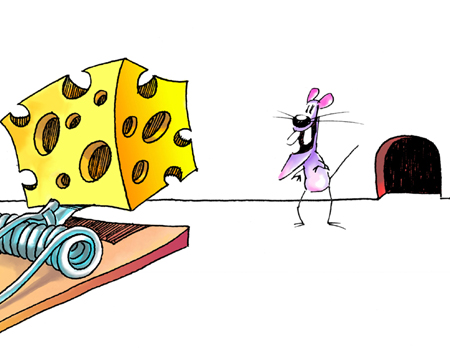
DL: The Mouse in "The Mousochist" may appear to be ignoring the cheese by reading a newspaper or exercising...but, it's really on his mind the whole time.

JRD: Right. But, also it's about going against his nature. I mean, how could he avoid the cheese? If there's something you desire it's going to be pretty hard to walk away from it. Why do we do the things (that at least on some level) we know is going to bring us harm? In the end, he got his cheese. Psychologically, it's fulfilling. But, how do you get out of it? I doubt he'll ever attach to his body again...and even if he does, is he going to be the same mouse? I don't think I executed the picture well enough...I'm not certain that people know that the mouse knows that the cheese is attached to a mouse trap. I've failed in that regard.

The Mousochist, we did in an island in Croatia on the Adriatic Sea. I was there and no one spoke English. I was staying at this beautiful place but, I wasn't talking to anyone and no one could talk to me. Between breakfast and lunch I would animate and then after lunch when everyone else was taking a siesta I would do it again and then go to the beach. It was just fabulous. It just worked out. The drawings are this big (gestures a 6 field). John pulls out a box of index card size drawings from The Mousochist. Including the mini BG.

DL: Did you corner register all the drawings?
JRD: Yeah, that's what I did. J. Stuart Blackton. The drawings are just shy of a 6 field. I had this metal straight edge that I held the drawings against. By the second week, I could flip five of these drawings! Talk about needing to draw and make something. I actually feel pretty comfortable doing little tiny drawings.

DL: What other creative endeavors do you have going on that people know least about?
JRD: Don't you feel that our lives should be creative in everything we do? As best that we can do? I mean, do I knit, do I cook? Yeah I do those things. I transplant trees. I sculpt. I paint. I do what you can. But, I don't know what else I'd be doing if there wasn't animation. Being in the service of other human beings would be a high thing for me. If I couldn't draw anymore, I'd be in some humanitarian field.

DL: What is the next big challenge for you? Any interest in working in feature films?
JRD: There's many things. I want to do this short CGI film. I'm also going to work on a new short film, something more substantial. We're waiting to hear word on a new pilot for Cartoon Network. I'd like to start development on a Courage feature. But, we'll see, I have to go down and start meeting with people....now that Power Puffs has come around. Courage would look fantastic as a feature, visually. I have a story. I just have to get the momentum. Courage is winding down now. By August or end of July we deliver our last show. Then I can focus more on the pilot and the feature. It's what I'd love to do. Then I also want to do an independent feature.

DL: A la Bill Plympton?
JRD: God! Is he not our hero?

DL: What does the "R" stand for in John R. Dilworth?
JRD: Rumplestilskin. Raamses. Reticent.


Courage the Cowardly Dog, season one, is available on DVD.